Posts

Showing posts with the label #Astrophysics

"New Discovery: Galaxies Are Much Larger Than We Thought! First Images of Galactic Halo Unveil Surprising Details"

Image
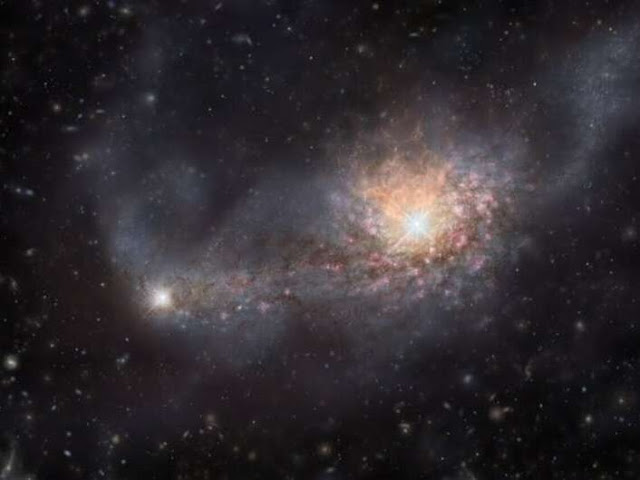
  Galaxies Just Got Bigger! 🌌 Recent breakthroughs have unveiled something astonishing—galaxies, including our Milky Way, are far more extensive than previously thought! For the first time, astronomers have captured an image of the gas halo surrounding a galaxy, and it's a game-changer. This discovery shows that galaxies are not just clusters of stars but massive gas reservoirs extending much farther than imagined. The gas shroud around starburst galaxy IRAS 08339+6517. Credit: Cristy Roberts ANU/ASTRO 3D. Using the Keck Cosmic Web Imager in Hawai'i, scientists studied the galaxy IRAS 08339+6517, located 260 million light-years away. The new imaging reveals that its gas halo stretches to 100,000 light-years, dwarfing the stellar disc, which is just 7,800 light-years across. The study also indicates that the Milky Way already interacts with the Andromeda Galaxy, which lies just 2.5 million light-years away. Gas flows into galaxies along spiralling filaments. This image of a ga...

Unraveling the Mysteries of X-Ray Radiation from Black Holes!

Image
 Scientists from the University of Helsinki have cracked a major cosmic puzzle! Through cutting-edge supercomputer simulations , they’ve discovered how magnetic fields around black holes cause chaotic turbulence that heats plasma and produces the X-ray radiation that we can observe from Earth. This breakthrough could change how we understand the dynamics of these mysterious cosmic giants. Visualization shows how the turbulent plasma moves in the magnetized accretion disk corona. Credit: Jani Närhi The Science Behind Black Holes Black holes are formed when massive stars collapse, creating an object so dense that nothing, not even light, can escape its grasp. Though we can't see black holes directly, their influence on nearby stars and gas reveals their presence. In a binary system, black holes slowly consume their companion stars, forming a glowing disk of matter known as an accretion disk. These disks are sources of intense X-rays, helping us observe the otherwise invisible bla...

Massive Star Deaths Create Gravitational Ripples Across the Universe

Image
A new study has uncovered that the explosive deaths of massive , spinning stars can send gravitational waves rippling across the universe , detectable right here on Earth. These stellar explosions, known as collapsars , occur when stars 15-20 times the mass of the Sun exhaust their nuclear fuel, collapsing inwards and forming black holes . After the death of a massive, spinning star, a disk of material forms around the central black hole. As the material cools and falls into the black hole, new research suggests that detectable gravitational waves are created. Credit: Ore Gottlieb. The intense implosion and subsequent explosion leave behind a swirling disc of matter around the black hole, which distorts space and generates powerful gravitational waves. These waves, traveling across the cosmos, have the potential to be detected by instruments like the Laser Interferometer Gravitational-Wave Observatory (LIGO) , which first observed such waves in 2015. LIGO Lead researcher Ore Gottlie...

"Astronomers Witness Ancient Cosmic Merger: Monster Galaxy Forming 12.8 Billion Years Ago!"

Image
Astronomers have made an incredible discovery of a pair of galaxies merging 12.8 billion years ago , which will deepen our understanding of early galaxy evolution. This cosmic dance is expected to birth a "monster galaxy" —one of the universe's brightest and most powerful objects . Artist's impression of the interacting galaxies observed in this research. The gravitational interactions during the merger trigger both starburst and quasar activity. Credit: ALMA (ESO/NAOJ/NRAO), T.Izumi et al. Using the ALMA radio telescope, an international team led by Takuma Izumi studied these galaxies in the constellation Virgo during the universe's infancy, just 900 million years after the Big Bang. The team observed a "bridge" of gas and dust connecting the galaxies, confirming that they were in the process of merging. This discovery suggests that the merger will result in more vigorous quasar activity caused by gas falling into supermassive black holes and lead t...

"Astronomers Discover a Mysterious Lithium-Rich Star: A New Chapter in Stellar Evolution!"

Image
Astronomers have made an exciting discovery of a peculiar lithium-rich star named J0524-0336 that challenges current theories of stellar evolution. This red giant, which is about 40 times the size of our Sun, has been found to contain 100,000 times more lithium than our Sun at a similar stage of life. The discovery, published in the Astrophysical Journal , could indicate a new evolutionary phase in a star's life cycle. Artist rendering of a red giant. Credit: DarkBlackKnight / Wikimedia Commons. (CC-BY-SA-4.0) Stars typically burn lighter elements like hydrogen, helium, and lithium to produce heavier ones through nuclear fusion. However, J0524-0336 defies the norm, suggesting that unknown mechanisms might be at play that allow this star to retain or produce lithium in large amounts. The research team led by Professor Rana Ezzeddine from the University of Florida proposes two possibilities: either J0524-0336 is undergoing a new evolutionary phase, or it may have absorbed a lithiu...

"First-Ever Accurate Simulation Shows How Supermassive Black Holes Rip Stars Apart—Astrophysicists Unveil New Cosmic Secrets!"

Image
 Monash University , Australia's astrophysicists have achieved a groundbreaking milestone by creating the first accurate simulation of a supermassive black hole shredding a star . This cosmic dance, known as a tidal disruption event (TDE) , reveals black holes' fascinating and violent nature. An illustration of a supermassive black hole   (Image credit: MARK GARLICK via Getty Images) According to lead scientist Professor Daniel Price, this study helps explain why stars falling into black holes emit visible light rather than X-rays—a mystery until now. Price compares the event to overeating: the black hole can't process the excess material, resulting in a massive 'cosmic burp' of energy. This simulation provides critical insight into these events and prepares astronomers for the flood of observations expected from the upcoming Rubins Observatory in Chile. Stay tuned as more stars fall prey to these galactic giants! By:- Ranjan #SupermassiveBlackHole, #TidalDisrupti...

"Mystery Unveiled: Plasma Bubbles Powering Fast Radio Bursts Finally Confirmed!"

Image
  Astrophysicists have made a groundbreaking discovery that brings us closer to understanding one of the universe's most mysterious phenomena— Fast Radio Bursts (FRBs) . A new study by the Italian National Institute for Astrophysics (INAF) has confirmed that plasma bubbles are responsible for the persistent radio emissions linked to these powerful cosmic events. An artistic representation of a magnetar, surrounded by the nebula responsible for..... FRBs, which release immense energy within milliseconds, have puzzled scientists since their discovery a little over a decade ago. This latest research focused on FRB20201124A, located 1.3 billion light-years away, and uncovered that a plasma bubble surrounding a magnetar or high-accretion X-ray binary is the source of the persistent radio signals. Using the world's most sensitive radio telescope, the Very Large Array (VLA) in the USA, scientists were able to measure the weakest persistent emission ever detected for an FRB. This fi...

Galactic Symphony: Pulsar Timing Arrays Detect Long-Period Gravitational Waves

Image
  Astrophysicists have made a groundbreaking discovery by detecting long-period gravitational waves using data from 68 pulsars . This significant finding, reported by NANOGrav , aligns with predictions of general relativity and provides new insights into supermassive black holes and galaxy mergers. Artist’s interpretation of an array of pulsars being affected by gravitational ripples produced by a supermassive black hole binary in a distant galaxy. Credit: Aurore Simonnet for the NANOGrav Collaboration Using large radio telescopes, researchers observed cosmic clocks to find evidence for gravitational waves oscillating over years to decades. This continuous signal followed over 15 years, transforms our sector of the Milky Way into a vast gravitational-wave detector. Pulsars, the ultra-dense remnants of massive stars, serve as precise cosmic timepieces. By monitoring 68 pulsars with facilities like Arecibo Observatory and Green Bank Telescope, NANOGrav has shown the first evidence f...

Dark Matter Revealed: Galaxy Cluster Collision Unveils Astonishing Speeds

Image
  Astronomers have made groundbreaking discoveries in studying dark matter by observing a unique collision between two galaxy clusters . This monumental event showcases the separation of dark matter from ordinary matter, offering new insights into the mysterious nature of dark matter and setting the stage for future research. This artist’s concept shows what happened when two massive clusters of galaxies, collectively known as MACS J0018.5, collided: The dark matter in the galaxy clusters (blue) sailed ahead of the associated clouds of hot gas, or normal matter (orange). Both dark matter and normal matter feel the pull of gravity, but only the normal matter experiences additional effects like shocks and turbulence that slow it down during collisions. Credit: W.M. Keck Observatory/Adam Makarenko Key Findings Collision of Galaxy Clusters: Astronomers observed the collision between two massive clusters, MACS J0018.5+1626, revealing that dark matter and ordinary matter decouple dur...

Soar through the Pillars of Creation: NASA's Mesmerizing New Video

Image
  NASA has unveiled a breathtaking new video that takes viewers on a 3D journey through the iconic Pillars of Creation . This mesmerizing animation results from a groundbreaking collaboration between NASA's most powerful space telescopes— the Hubble Space Telescope and JWST (the James Webb Space Telescope) . The Pillars of Creation as seen by the Hubble Space Telescope and the James Webb Space Telescope. Credit: Greg Bacon, Ralf Crawford, Joseph DePasquale, Leah Hustak, Christian Nieves, Joseph Olmsted, Alyssa Pagan, and Frank Summers (STScI), NASA's Universe of Learnin A Historic Collaboration The Pillars of Creation, located 6,500 light-years away in the Eagle Nebula (M16), have fascinated researchers and the public since Hubble first captured their image in 1995. Now, with the combined efforts of Hubble and JWST, the star-forming clouds are brought to life in stunning detail. This animation is not just an artistic interpretation but is based on observational data led by...

James Webb Telescope Unveils Enigmatic Star Jets: A Glimpse into the Birth of Stars!

Image
The JWST (James Webb Space Telescope) has once again stunned the scientific community with an extraordinary discovery. A team of astronomers has observed a group of newborn stars in the Serpens Main nebula shooting high-speed gas jets in nearly identical directions. This phenomenon, never seen before, could revolutionize our understanding of star formation. Unveiling the Mystery The JWST's powerful Near-Infrared Camera (NIRCam) captured these baby stars, revealing protostellar outflows—massive jets of gas released by newly formed stars. What makes this discovery astonishing is the alignment of these jets. Despite originating from stars separated by vast distances, the jets point in the same direction, akin to sleet pouring down during a storm. A Historical Record of Star Formation Klaus Pontoppidan, the principal investigator from NASA's Jet Propulsion Laboratory, explained that this alignment directly examines how stars are born. These aligned structures serve as a historic...