Posts

Showing posts with the label Nebula

"Stellar Collision Unveils Magnetic Mystery: Clash of Stars in Nebula Solves Age Discrepancy" ๐Ÿ‘ฉ๐Ÿป‍๐Ÿš€๐ŸŒŒ

Image
When astronomers peered into the heart of a mesmerizing cloud of gas and dust, they stumbled upon a celestial drama of epic proportions. Typically, star pairs resemble twins, but in the case of HD 148937, they discovered a tale of cosmic collision, rewriting the stars' destiny forever. New revelations from the European Southern Observatory (ESO) shed light on a stellar enigma within the nebula NGC 6164/6165. This intriguing system, located approximately 3800 light-years away in the Norma constellation, comprises two massive stars embraced by a captivating nebula—a rare sight in the cosmos. Lead author Abigail Frost, an astronomer at ESO in Chile, remarks, "The uniqueness of this system struck us profoundly. It's not every day we encounter such a celestial spectacle." The discovery unveils an age-old mystery, challenging conventional understanding of star formation and evolution. The system's perplexing characteristics, including an age gap of at least 1.5 million ...

"Intense Radiation from Orion's Stars Vaporizing Young Star's Planetary Dreams, Reveals JWST Data" ๐ŸŒ•๐ŸŒŒ

Image
The Orion Nebula , a celestial marvel, captivates stargazers worldwide with its ethereal beauty. Yet, amidst its grandeur lies a tale of cosmic tragedy unfolding for a young star and its dreams of planetary formation. In a recent revelation, data from the James Webb Space Telescope (JWST) and the Atacama Large Millimeter-submillimeter Array (ALMA) has uncovered a sobering reality - the protoplanetary disk, dubbed d203-506, orbiting a small red dwarf in the Orion Nebula, is facing a brutal fate. Initially destined for the birth of planets, this disk is being relentlessly vaporized by intense bursts of far-ultraviolet (FUV) radiation emitted by its massive neighboring stars. Olivier Berne, an astrophysicist leading the study, elucidates that the relentless FUV radiation fields excite the gas particles within the disk, propelling them to escape velocity and dispersing into the vastness of the interstellar medium. Each year, the disk loses an Earth-mass worth of material, jeopardizing its ...

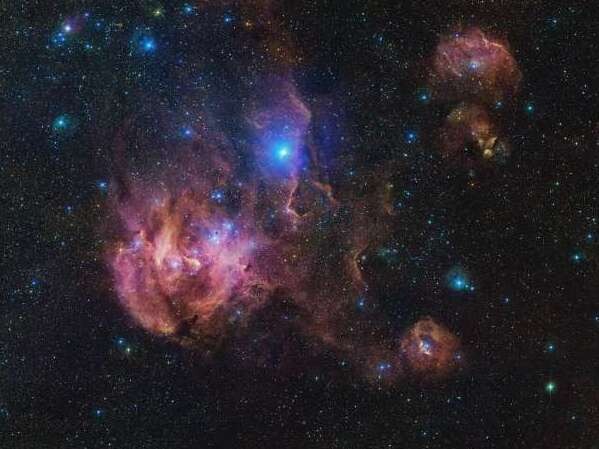
"Running Chicken Nebula๐ŸŒŒ in Amazing 1.5-Billion-Pixel Detail!" ๐Ÿ›ฐ๐Ÿ”ญ๐ŸŒŒ

Image
Instead of the usual festive stuff this holiday season, treat yourself to a fantastic celestial display! The Running Chicken Nebula, home to young stars, has been revealed in stunning detail with a massive 1.5-billion-pixel image from the European Southern Observatory (ESO). The VLT Survey Telescope (VST) captured the fantastic picture at the ESO's Paranal site in Chile. Located in the Centaurus constellation , about 6,500 light-years away, the Running Chicken Nebula shines in bright pink, thanks to the intense radiation from its young stars. The gigantic image covers a space in the sky equal to about 25 full moons and highlights various areas, with IC 2948 being the brightest. Some people even see a chicken's head or rear end in this region, while wispy gas and dust add a magical touch to the cosmic scenery. Looking closely at the image, you'll spot IC 2944 with its bright pillar-like structure and Lambda Centauri , a star we can see with the naked eye, closer to us than...