Posts

Showing posts with the label ISRO

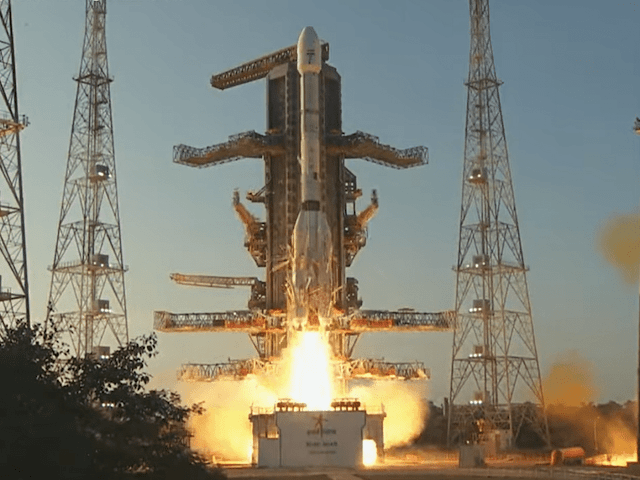
INSAT-3DS Launch Today: Unraveling the Mystery of ISRO's "Naughty Boy" Rocket🚀😊
Image
Today marks a significant milestone in India's space endeavors as the Indian Space Research Organisation (ISRO) gears up to launch its GSLV F14/INSAT-3DS mission from the Sriharikota launch site. This mission aims to revolutionize weather forecasting and disaster management by deploying the INSAT-3DS meteorological satellite. Why the "Naughty Boy" Moniker?:   Amidst the excitement surrounding the INSAT-3DS launch, the spotlight inevitably falls on the carrier rocket, GSLV F14, affectionately dubbed the "naughty boy" of ISRO. But why such a playful nickname? The answer lies in its turbulent history marked by technical glitches and challenges. The Significance of INSAT-3DS:   While the GSLV F14 has had its share of ups and downs, the INSAT-3DS mission holds immense importance for India's weather forecasting agencies. Equipped with advanced capabilities, this satellite promises to deliver unparalleled accuracy in weather predictions and disaster warnings...
Chandrayaan-3 Reborn: Tiny NASA Craft Bounces Light, Big Leap for Lunar Exploration😊🛰

Image
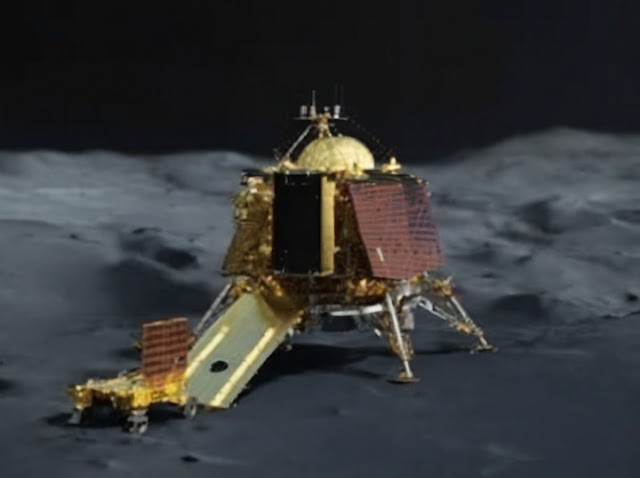
Hold onto your spacesuits, space enthusiasts! India's Chandrayaan-3 mission, seemingly lost on the moon's surface, has taken a giant leap back toward life. It all started with a tiny NASA spacecraft , the Lunar Reconnaissance Orbiter (LRO), playing a cosmic game of laser tag with a curious companion – an Oreo-sized device on the Vikram lander. This ping-pong match of light beams proved to be more than just fun and games. The successful bounce, announced by NASA, unveiled a groundbreaking new method for pinpointing locations on the lunar surface with pinpoint accuracy. And wouldn't you know it, this newfound precision holds the key to a future filled with moonwalking astronauts! Here's why this tiny, laser-wielding hero is making moon-landing headlines Vikram Reborn:  Chandrayaan-3's Vikram lander crash-landed on the moon in 2023, its fate uncertain. But we know exactly where it rests thanks to the LRO's laser light show. This means engineers can analyze the la...

India's Aditya-L1 Solar Observatory Successfully Enters Orbit around Lagrange Point! 🛰🌞🌌

Image
In a historic achievement, India's Aditya-L1 solar observatory has successfully entered its designated orbit around the Sun-Earth Lagrange point 1 , located approximately 1.5 million kilometers from Earth. This groundbreaking mission, the country's first dedicated venture to study the Sun, positions India as a significant player in space exploration. On Twitter, Indian Prime Minister Narendra Modi declared the achievement, announcing that Aditya-L1 secured its orbital position at approximately 5:30 a.m. Eastern on January 6. It will contribute to advancing our comprehension of solar phenomena. Mission Objectives: Aditya-L1's halo orbit at Lagrange point 1 offers a unique vantage point for continuous study of the Sun. The spacecraft has seven indigenously developed scientific instruments, including an ultraviolet imaging telescope, soft and hard X-ray spectrometers, a coronagraph for solar observations, particle analyzers, and a magnetometer for in-situ measurements. The p...

India Launches First Satellite to Probe Black Holes After the US🌌🛰🧐

Image
In a giant leap towards unraveling the mysteries of the cosmos, India marked a historic moment on Monday with the launch of its first satellite dedicated to studying black holes . The spacecraft, known as the X-ray Polarimeter Satellite , aims to further India's engagement in space exploration and pave the way for an upcoming ambitious crewed mission scheduled for the following year. The X-ray Polarimeter Satellite, weighing around 1,000 pounds, achieved successful orbit deployment from an island close to Sriharikota , a central hub for India's space initiatives. S. Somanath , the chairman of the ISRO (Indian Space Research Organisation), disclosed that the satellite's primary research objective is the study of X-rays emitted by approximately 50 celestial objects. This mission is strategically designed to enhance our understanding of these enigmatic cosmic phenomena significantly. The satellite will carry out its mission with the help of two payloads, expertly crafted b...