Posts

Showing posts with the label #CosmicDiscovery

Final Parsec Problem Solved: Dark Matter's Role in Black Hole Mergers

Image
  Scientists may have found a solution to the " final parsec problem ," which has made it difficult to explain how supermassive black holes (SMBHs) form. This breakthrough points to a mysterious form of dark matter as the key to resolving the issue. An illustration of two supermassive black holes about to collide.   (Image credit: Getty) Supermassive black holes grow through repeated mergers of smaller holes, but their formation has been puzzling due to a persistent problem. When black holes get close, they seem to orbit indefinitely instead of merging. Known as the "final parsec problem," this issue occurs when the black holes reach a separation of about one parsec (3.26 light-years) and become stuck, unable to lose enough energy to collide and merge. A pair of giant black holes about 3,000 light-years apart in the galaxy NGC 6240, 400 million light-years away. The galaxy's butterfly shape was caused by the collision of two smaller galaxies.  (Image credit: ...

Hubble Zooms Into Andromeda's Stunning Starry Tendrils: A Cosmic Rose Garden

Image
  NASA's Hubble Space Telescope has once again captured the awe of the cosmos , this time zooming into the rosy tendrils of our galactic neighbor —the Andromeda galaxy . Located 2.5 million light-years away, Andromeda (also known as M31 ) is a vast spiral galaxy measuring around 152,000 light-years across, making it the Milky Way's closest primary companion. Scientists probed Andromeda's spiral arms using Hubble to analyze the collection of stars buried in its cosmic bouquets. Credit: NASA, ESA, M. Boyer (Space Telescope Science Institute), and J. Dalcanton (University of Washington); Image Processing: Gladys Kober (NASA/Catholic University of America) The mesmerizing spiraling arms of Andromeda hold star-forming regions where stellar nurseries and supernovae work together to ignite surrounding hydrogen gas, creating a spectacle of star-studded roses in space. These cosmic gardens are teeming with activity, providing astronomers with valuable insights into stellar format...

Astronomers Rally to Save NASA's Chandra X-ray Observatory Amid Budget Cuts

Image
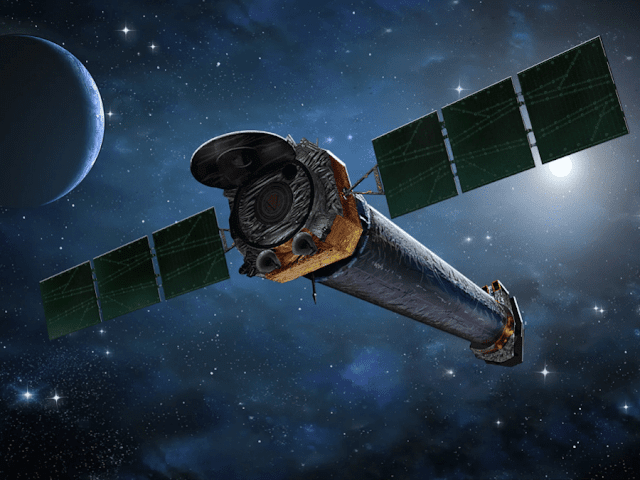
 In a dramatic bid to save one of NASA 's most productive space observatories, astronomers across the globe are uniting to prevent the shutdown of the Chandra X-ray Observatory . Launched in 1999 , Chandra has revolutionized our understanding of the universe by providing stunning insights into black holes , stellar explosions , and other cosmic wonders . Despite being fully operational with a decade of fuel left, NASA's budget shortfalls have placed the telescope on the chopping block. An artist's impression of the Chandra X-ray Observatory. Credit: NASA/CXC & J. Vaughan This decision has sparked worldwide protests under the #SaveChandra movement, with scientists warning that shutting down such a technologically advanced telescope would leave an irreplaceable gap in X-ray astronomy. Chandra's unique ability to provide high-resolution images of distant cosmic phenomena remains unmatched by any existing or upcoming projects from Europe or China. NASA released this c...

"First-Ever Accurate Simulation Shows How Supermassive Black Holes Rip Stars Apart—Astrophysicists Unveil New Cosmic Secrets!"

Image
 Monash University , Australia's astrophysicists have achieved a groundbreaking milestone by creating the first accurate simulation of a supermassive black hole shredding a star . This cosmic dance, known as a tidal disruption event (TDE) , reveals black holes' fascinating and violent nature. An illustration of a supermassive black hole   (Image credit: MARK GARLICK via Getty Images) According to lead scientist Professor Daniel Price, this study helps explain why stars falling into black holes emit visible light rather than X-rays—a mystery until now. Price compares the event to overeating: the black hole can't process the excess material, resulting in a massive 'cosmic burp' of energy. This simulation provides critical insight into these events and prepares astronomers for the flood of observations expected from the upcoming Rubins Observatory in Chile. Stay tuned as more stars fall prey to these galactic giants! By:- Ranjan #SupermassiveBlackHole, #TidalDisrupti...

"Webb Space Telescope Unveils Key Insights on Universe's Expansion Rate – Is the Hubble Tension Real?"

Image
  The mystery behind the universe's expansion rate may finally be solved , thanks to new data from NASA's James Webb Space Telescope . For over two decades, astronomers have debated the " Hubble constant ," a value essential to understanding how fast the universe is expanding. This debate, known as the " Hubble tension ," had two conflicting measurements, suggesting that something might be missing from our universe model. Scientists used new data taken by the James Webb Space Telescope to make a  However, a recent study led by renowned cosmologist Wendy Freedman of the University of Chicago indicates that there may not be a conflict after all. Freedman and her team used the Webb Telescope to measure the distance to ten nearby galaxies, finding that the expansion rate was about 70 kilometers per second per megaparsec, aligning closely with previous methods. An artist's concept showing the expansion of the universe over time since the Big Bang By using th...

James Webb Telescope Sees 'Birth' of Three of the Universe's Earliest Galaxies in World-First Observations

Image
  In an astounding breakthrough, the James Webb Space Telescope (JWST) has captured the birth of some of the universe's earliest galaxies. This unprecedented observation marks the first time astronomers have witnessed such early galactic formation. The Discovery A new study published in Science reveals that JWST detected three infant galaxies forming from a primordial cloud of hydrogen and helium gas just 400 to 600 million years after the Big Bang. This period is known as the era of reionization, a crucial phase when the earliest stars and galaxies began to shine through dense gas clouds, leading to the transparent universe we know today. "These galaxies are like sparkling islands in a sea of otherwise neutral, opaque gas," said Kasper Heintz, lead author and assistant professor of astrophysics at the Cosmic Dawn Center (DAWN), University of Copenhagen. "Without Webb, we would not be able to observe these very early galaxies, let alone learn so much about their form...