Posts

Showing posts with the label #SpaceExploration

"Artemis III Lunar Landing Sites Identified: Revolutionary Mapping and AI Techniques Unveil Ideal Locations"

Image
  In a groundbreaking study, scientists have identified potential landing sites for NASA's Artemis III mission using advanced Geographic Information Systems (GIS) and Multi-Criteria Decision-Making (MCDM) techniques. This research, submitted to Acta Astronautica and available on the arXiv preprint server, combined mapping with an AI-based algorithm, paving the way for a new method of determining lunar landing sites. The 13 candidate landing site regions for NASA’s Artemis III mission, with each region measuring approximately 15 by 15 kilometers (9.3 by 9.3 miles). Final landing sites within those regions measure approximately 200 meters (656 feet) across. Credit: NASA NASA initially identified 13 potential landing regions near the lunar south pole, with one, in particular, standing out. Site DM2, located near Nobile Rim 2, was revealed as the ideal location based on criteria like solar illumination, communication with Earth, and the potential for water ice deposits in Permanently...

NASA’s Parker Solar Probe Gears Up for Final Venus Flyby, Inches Closer to the Sun!

Image
  NASA's Parker Solar Probe is gearing up for its seventh and final Venus flyby on November 6, 2024 . The spacecraft performed a small but critical maneuver on August 26 , adjusting its course to bring it closer to Venus. This final flyby is essential to ensure that the Parker Probe can eventually get within 3.8 million miles of the Sun's surface , closer than ever before. Venus imaged by the Magellan spacecraft. Credit: NASA/JPL The maneuver lasted only 17 seconds , bringing the spacecraft 386 miles closer to its target, allowing Parker to approach 240 miles above Venus' surface. This flyby is critical to using Venus' gravity to tighten the spacecraft's orbit around the Sun. After passing Venus, Parker Solar Probe will break records again, whizzing past the Sun at a mind-blowing 430,000 miles per hour on December 24, 2024 . The current phase of the mission, the 21st orbit , is set to conclude with a solar encounter on September 30, 2024 , coming just 4.51 milli...

Exploring Life’s Origins: Astrobiologist Manasvi Lingam’s Journey to Unlock Earth's Biggest Mysteries

Image
  From a young age, Manasvi Lingam , an assistant professor of astrobiology at Florida Tech , has been captivated by the mysteries of life's origins . As a child, he would bombard his family with questions about dinosaurs and aliens , seeking to understand how life could exist on other planets. Credit: Pixabay/CC0 Public Domain Today, Lingam has turned his childhood curiosity into groundbreaking research. His latest study uses Bayesian analysis to explore the possibility of life originating on Earth from non-life, also known as abiogenesis . Collaborating with researchers from Florida Tech and the University of Rome, Lingam developed models to analyze how many sites on Earth could have been suitable for life to start and how likely life was to emerge at those sites. Surprisingly, Lingam found that having fewer suitable sites for life increased the likelihood of life's emergence. This counterintuitive finding challenges the notion that "more is better" and opens up ...

Recent Volcanic Activity Found on the Moon! A Discovery That Could Change History 🌕🔥

Image
  For decades, scientists believed volcanic activity on the Moon ceased around 2 billion years ago . However, surprising new findings suggest that volcanoes on the Moon may have been active much more recently than we thought— just 120 million years ago! Credit:  NASA/GSFC/Arizona State University This shocking discovery comes from analyzing lunar rock and soil samples brought back to Earth by China's Chang'e 5 mission. The samples collected from the Moon's Oceanus Procellarum region revealed volcanic droplets that were much younger than expected. These findings were recently published in the journal Science and have caused quite a stir in the scientific community. But how did volcanic activity on the Moon last this long? The answer may lie beneath the lunar surface. Some areas of the Moon's interior might have been enriched with heat-producing radioactive elements. These elements could have fueled volcanic eruptions long after most of the Moon's surface had coole...

"New Discovery: Galaxies Are Much Larger Than We Thought! First Images of Galactic Halo Unveil Surprising Details"

Image
  Galaxies Just Got Bigger! 🌌 Recent breakthroughs have unveiled something astonishing—galaxies, including our Milky Way, are far more extensive than previously thought! For the first time, astronomers have captured an image of the gas halo surrounding a galaxy, and it's a game-changer. This discovery shows that galaxies are not just clusters of stars but massive gas reservoirs extending much farther than imagined. The gas shroud around starburst galaxy IRAS 08339+6517. Credit: Cristy Roberts ANU/ASTRO 3D. Using the Keck Cosmic Web Imager in Hawai'i, scientists studied the galaxy IRAS 08339+6517, located 260 million light-years away. The new imaging reveals that its gas halo stretches to 100,000 light-years, dwarfing the stellar disc, which is just 7,800 light-years across. The study also indicates that the Milky Way already interacts with the Andromeda Galaxy, which lies just 2.5 million light-years away. Gas flows into galaxies along spiralling filaments. This image of a ga...

NASA's Race to Unlock Io's Volcanic Secrets: Two New Mission Proposals Underway!

Image
  NASA 's current Juno mission has revealed unprecedented details about Jupiter's volcanic moon Io . However, more questions arise with each discovery, pushing scientists to propose dedicated missions to study this unique world. Io, the most geologically active body in the Solar System, has over 400 active volcanoes shaped by Jupiter's intense gravitational pull. This tidal force heats Io's interior, creating magma and driving its explosive volcanic eruptions. Juno captured this image of Io during Perijove 57. Juno's images of the volcanic moon are adding momentum to the calls for a mission to the moon. Is it time? Image Credit: NASA / SWRI / MSSS / Jason Perry © cc nc sa This schematic of Jupiter’s magnetic environments shows the planet’s looping magnetic field lines, Io and its plasma torus, and Io’s flux tube. Credit: John Spencer / Wikipedia CC-BY-SA3.0 with labels by the author There are now two proposed missions aimed at uncovering Io's mysteries. The ...

Unraveling the Mysteries of X-Ray Radiation from Black Holes!

Image
 Scientists from the University of Helsinki have cracked a major cosmic puzzle! Through cutting-edge supercomputer simulations , they’ve discovered how magnetic fields around black holes cause chaotic turbulence that heats plasma and produces the X-ray radiation that we can observe from Earth. This breakthrough could change how we understand the dynamics of these mysterious cosmic giants. Visualization shows how the turbulent plasma moves in the magnetized accretion disk corona. Credit: Jani Närhi The Science Behind Black Holes Black holes are formed when massive stars collapse, creating an object so dense that nothing, not even light, can escape its grasp. Though we can't see black holes directly, their influence on nearby stars and gas reveals their presence. In a binary system, black holes slowly consume their companion stars, forming a glowing disk of matter known as an accretion disk. These disks are sources of intense X-rays, helping us observe the otherwise invisible bla...

NASA's Groundbreaking Discovery: Invisible Electric Field Detected Around Earth for the First Time!

Image
In a groundbreaking discovery, NASA scientists have detected a weak yet vital energy field around Earth , the ambipolar electric field . Hypothesized over 60 years ago, this field was recently measured for the first time and could revolutionize our understanding of Earth's atmosphere, its evolution, and even life itself. Earth's North Pole, as seen by  Endurance . The streaks in the sky are from lens flare. ( NASA ) NASA's Endurance mission, launched in May 2022, successfully detected this invisible force at a high altitude of 768 kilometers. The field measured only 0.55 volts—equivalent to a watch battery—. Still, that tiny charge is powerful enough to launch hydrogen ions into space at supersonic speeds, contributing to the polar wind. Simulation This electric field, which balances the forces of gravity and charged particles in Earth's atmosphere, plays a crucial role in puffing up the ionosphere and allowing particles to escape into space. Understanding this field o...

"James Webb Space Telescope Discovers Six Rogue Worlds Drifting in Space: A New Window into Star and Planet Formation"

Image
 The James Webb Space Telescope (JWST) has made a groundbreaking discovery, spotting six mysterious " rogue worlds " in a young star-forming nebula about 1,000 light-years away. These rogue worlds are planet-like objects that drift through space without being bound to any star. Among the discoveries, the lightest and most fascinating rogue world is surrounded by a dust disc, which researchers believe could form its mini-planetary system. Wide field view mosaic of NGC1333 with 3 of the newly discovered objects (NN1, NN2, NN3) indicated by green markers. Credit: ESA/Webb, NASA & CSA, A. Scholz, K. Muzic, A. Langeveld, R. Jayawardhana Dr. Aleks Scholz from the University of St Andrews, UK, shared that this rogue world might be a miniature planetary system nursery. Unlike typical stars, these objects didn't gather enough mass to trigger nuclear fusion, which powers stars. Instead, they float freely through the cosmos, offering valuable insights into star and planet for...

"Astronomers Witness Ancient Cosmic Merger: Monster Galaxy Forming 12.8 Billion Years Ago!"

Image
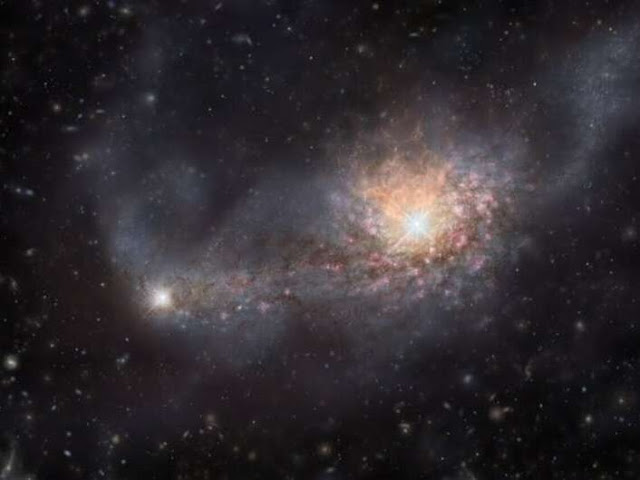
Astronomers have made an incredible discovery of a pair of galaxies merging 12.8 billion years ago , which will deepen our understanding of early galaxy evolution. This cosmic dance is expected to birth a "monster galaxy" —one of the universe's brightest and most powerful objects . Artist's impression of the interacting galaxies observed in this research. The gravitational interactions during the merger trigger both starburst and quasar activity. Credit: ALMA (ESO/NAOJ/NRAO), T.Izumi et al. Using the ALMA radio telescope, an international team led by Takuma Izumi studied these galaxies in the constellation Virgo during the universe's infancy, just 900 million years after the Big Bang. The team observed a "bridge" of gas and dust connecting the galaxies, confirming that they were in the process of merging. This discovery suggests that the merger will result in more vigorous quasar activity caused by gas falling into supermassive black holes and lead t...

"NASA's Juno Mission Unveils Groundbreaking 3D Radiation Map of Jupiter's System, Paving the Way for Future Europa Missions"

Image
  Exciting news from NASA! A groundbreaking discovery brings us one step closer to sending missions to Jupiter's icy moon, Europa—a place scientists believe could harbor life beneath its frozen surface. This artist concept depicts the Juno spacecraft which arrived at Jupiter in 2016 after a five-year journey to study the giant planet. Credit: NASA Jet Propulsion Laboratory, JPL NASA's Juno mission has given us the first-ever detailed 3D radiation map of Jupiter's system, providing crucial data to help future missions navigate safely through the harsh environment surrounding Europa. Thanks to Juno's innovative use of star cameras, this radiation map is not only possible but is also changing the way scientists plan to explore one of the most intriguing moons in our solar system. Europa: A New Frontier With its vast icy crust and potential subsurface ocean, Europa has long been a space exploration target. However, one of the biggest hurdles has been the intense radiation ...